|
Any visitor to Europe will attest to the fact that there
are countless buildings in almost every town and city much older than
100 years that are well maintained and still in everyday use. In fact,
whole cities there have a marvelous historic character because of the
large number of historic landmarks.
But here's the paradox: in the United States a
building that is just 80 years old is considered "untenable" and "too
expensive to maintain.".
The United States being the world's most
prosperous nation, this is hard to understand. If any country can
afford to preserve its historic heritage, it should be the USA.
But the wealth of the United States may be its
undoing. Unfortunately in this country we have a mentality that "new"
is better than "old." Even If it costs less to maintain a historic
building than it does to build a new one, since we can afford to build
new, we think "Why not?" I suspect this is often the reason historic
structures are torn down to make way for new ones.
This appears to be the case with the Whiting
Community Center. In 2006, the Maximus Corp., as part of a study of
local government, recommended that the Whiting Community Center be
sold. Was this just a case of noticing an older building and taking the
easy way out in suggesting a way to cut expenses?
In any event, it would be interesting to see a
study comparing the cost of maintaining a historic building verses the
cost of building a new one. I'll bet many people would be surprised if
it found that maintaining a historic building is more cost-effective
than building new. For a new building, contractors and architects must
be hired. Land must be bought up and surveyed. Construction materials
must be purchased and the construction company must be paid. These
expenses come all at once as opposed to the cost of maintenance which
is spread over a longer period.
This is not to mention the intangible benefits
that a historic building adds to the community, the sense of character
and uniqueness it creates in this age of cookie cutter housing and
fast-food restaurants that all look alike.
In the case of the Whiting community center, there
is something that really deserves to be saved. In 2007 a nine-member
group was commissioned by Whiting mayor Joe Stahura to study the
center. Stahura said "The Whiting community center is a huge part of
our history, and we are still brainstorming opportunities to keep the
building viable."
Dedication of the building on Fishrupp and Clark
streets, then called the Whiting Memorial Community House, took place
on Veteran's Day, November 12th 1923. According to an article in the
June 10, 2007 Post-Tribune, it was dedicated by the American Legion
Post 80 in memory of Whiting residents who served during World War I.
The mayor at the time, Walter E. Schrage, asked that all businesses
close their doors on the day of the dedication. Those in attendance
were asked in the dedication program to stand at 11:00 a.m. "facing the
East for 30 seconds in silent prayer in memory of all World War I dead."
The building represents local history, and
especially Whiting history, in many ways. The building was a gift from
John D. Rockefeller Sr. and John D. Rockefeller Jr. The building cost
$450,000 to construct (in 1923 dollars), funding for which came from
the Rockefeller family and the Standard Oil Co..
The buildings still boasts rich amenities of the
type there no longer found in today's budget conscious
architecture--wood-paneled meeting rooms, a large swimming pool, a
bowling alley and 800 seat auditorium are just a few of the amenities.
The center is just as busy today as it was over 80
years ago. Piano, swimming and crochet classes are given and individual
rooms are available for meetings, special parties, and wedding
receptions.
Thousands of people visit the building every
month. Says former Whiting mayor Joseph Grenchik, "I pray this
administration and future administrations will find the will and means
to keep it going."
All photos by Timothy Arends
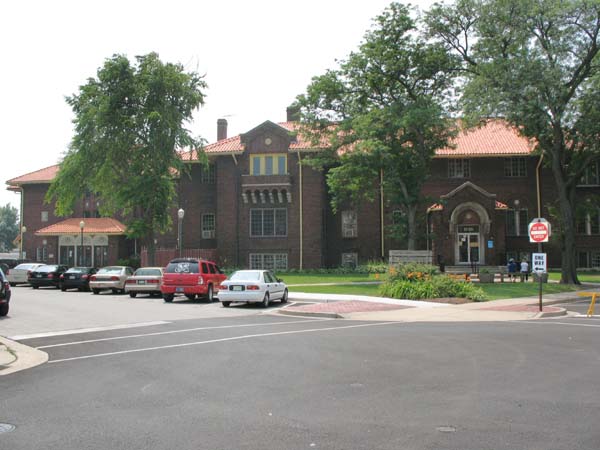
Front exterior of Whiting Community Center
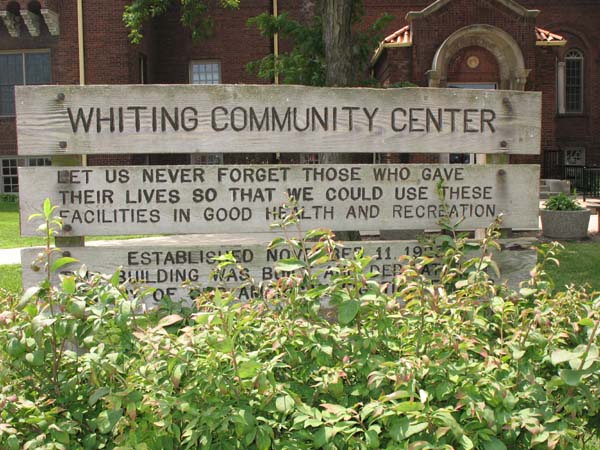
Sign in front of building reads:
Whiting Community Center
Let us never forget those who gave
their lives so that we could use these facilities in good health and
recreation.
Established November 11, 1923
This building was built and
dedicated in memory of our American fighting forces.
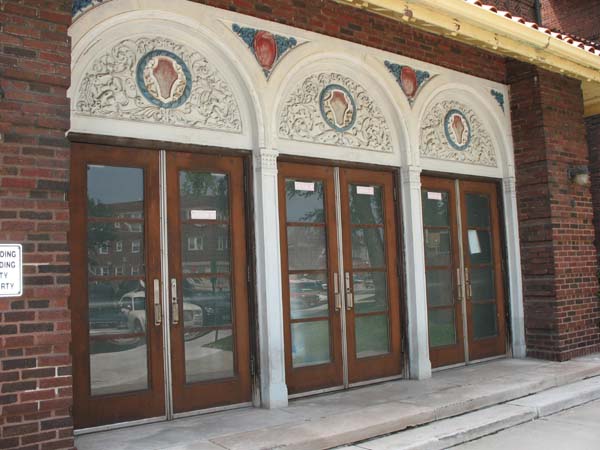
Terra-cotta ornamentation over entrance doors.
|