Images
of
Downtown Hobart
Indiana
Photos by
Tim Arends
While several
buildings in downtown Hobart Indiana have been altered over the years,
downtown Hobart still retains much of its historic charm. The downtown
area enjoys a high occupancy rate, yet has a generally adequete supply
of parking.
While the downtown
suffered for a while after the establishment of large shopping malls
nearby, downtown business people learned that the key to survival is to
specialize. In downtown Hobart one will find such unusual businesses as
a diver's supply store and a magic shop, along with old standbys such
as furniture stores, jewelry stores and restaurants.
Apparently, many
downtown businesses have recently received tax credits for refurbishing
their storefronts as part of a general downtown Hobart rehabilitation,
including the rehabilitation of the lakefront park. The city poured
more than $2.5 million into transforming the eastern shoreline of Lake
George from a rocky eyesore to a waterfront park with a walking path,
picnic area and fishing pier.
Unfortunately,
storefront owners were not being given education in historically
sensitive rehabilitation, with the result that still more buildings
were "modernized," with unfortunate results.
But possible good
news came from the Hobart Industrial Economic Development Corp., a
private development group, which has set aside $26,000 to help
businesses pay for architectural design.
Restoring the
original facades of downtown buildings would make the business district
more attractive, says architect Bob Collins, president of Fred Collins
Architect Inc., who is working with HIEDC. "The true architecture of
many buildings including detailed brick work has been hidden for one
reason or other."
The facade project is
the latest supported by HIEDC to make the area more appealing to
visitors and shoppers drawn by the city's revamped downtown waterfront.
The city is spending
more than $92,000 to rebuild the business district's sidewalks and
curbs, and install decorative streetlights that match the lights along
the lakefront.
"When downtown
businesses are ready to make improvements to their buildings, we would
like to offer them the services of an architect to work on their
facades," said Sheila DeBonis, HIEDC executive director.
Collins said the
facade program will make downtown Hobart more pedestrian-friendly. He
said that will be accomplished by scaling back shop signs and
uncovering the authentic architecture of the buildings.
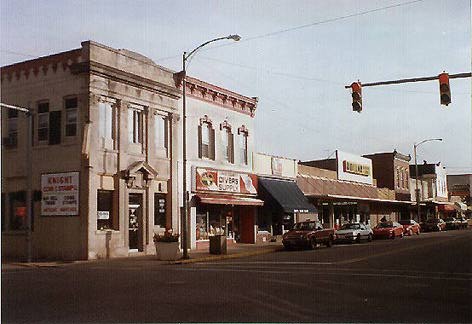
The historic section of downtown Hobart stretches
about two blocks. The former bank building (First State Bank) shown
here was built in 1888 and is of the Neoclassical style. Interestingly,
it was originally a red brick building. The stone facade was added in
1922. It now houses a coin shop, while a similar building right across
the street is now a jewelry store. Both are good examples of
alternative uses of historic buildings.
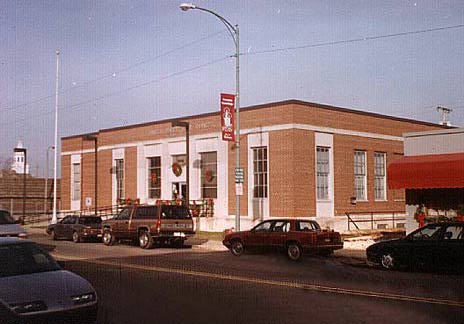
The Colonial Revival Main St. Post Office boasts a
WPA (Works Progress Administration) mural created in 1938 by William
Dolwick.
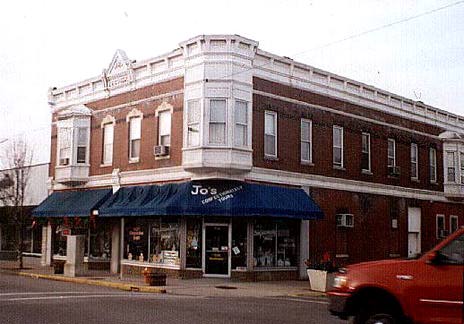
The Guyer Block building (1897), one of three
charming bay-windowed buildings, once housed the Hobart Post office. It
is now a confectionery shop (Third street). It is Italianate
Commercial, marked by the heavily-bracketed roof.
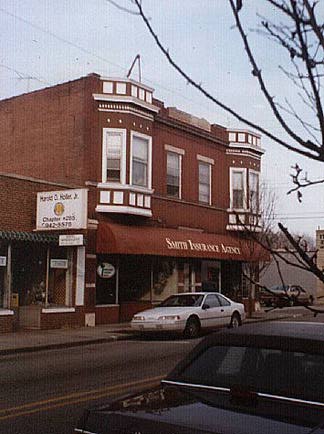
| The L.M.
Friedrich building (1910) also once housed the Hobart Post Office, as
well as one of Hobart's first dime stores, Thompson's 5 & 10.
It is now home to an insurance agency. Italianate Commercial. |
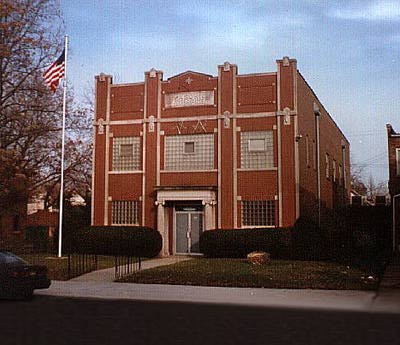
| Masonic Temple (1925),
site of Hobart's first schoolhouse (1845), boasts distinctive Colonial
Revival-style architecture. The Colonial Revival-style was an
adaptation and combination of Georgian and Colonial styles in the USA
toward the end of the 19th and into the 20th centuries. |
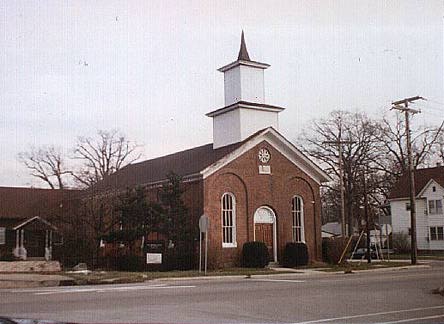
|
The First Unitarian Church, Hobart's oldest
church building (1874), is prominently located on Main St.
To visit downtown Hobart, from the Rt. 51
(Ripley) exit of I-94, go south approximately 3.5 miles to Main.
|
(Five Images)
|