|
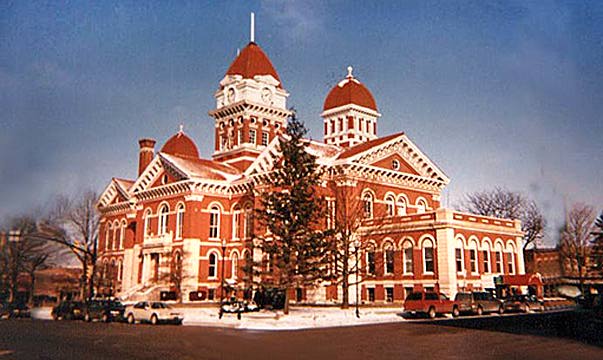
The "Grand Old Lady," as the Lake County
Courthouse is fondly called, was designed by J. C. Cochran of Chicago,
Illinois. It was to be built at a cost of $52,000 by Thomas and Hugh
Colwell of Ottawa, Illinois. In 1907, Beers and Beers of Chicago were
chosen as architects for the north and south two-story extensions of
the Court House with construction costs mounting to $160,000.00.
Since
its erection in 1878, this building, which combines Romanesque and
Georgian styles, has been a landmark in Lake County. It was saved from
demolition by a group of dedicated citizens (town leaders wanted to
turn it into a parking lot!), placed on the National Register of
Historic Places on May 17, 1973, and was rehabilitated by the Lake
County Court House Foundation, Inc.
It
now houses a plethora of unique shops and a museum featuring
memorabilia from the time the town was founded until the time the
county government vacated it.
All
around the square and on the streets that
extend therefrom, one finds shops that cater to almost every need. Many
of the buildings, such as Cheshire Hall, built in 1873, have
"modernized" fronts, but a number of the facades on the square date
back to the 1890s.
A
Brief Historical Review of The Lake County Indiana Courthouse
The
first permanent settlers in Lake County were Solon Robinson and Mariah
Evans Robinson. The family arrived in October 1834 near Crown Point,
the county seat, was founded in 1834 and incorporated in 1868. Solon
Robinson deeded the major portion of real estate on which the Court
House stands. In his conveyance, he clearly provided for "this land to
be used for a public square..."
The Court House has been, since its erection in 1878, a landmark in
Lake County. For many years it has been the most massive structure in
breadth and height constructed by early settlers, and can be seen for
miles on top of the morainic divide. The Court House displays a type of
architecture of the Victorian Period and a most interesting combination
of Romanesque and Georgian styles. It has a sort of quasi-military
effect in appearance.
The central portion, including the clock tower, was started in 1878,
dedicated in 1880 and cost $52,000.00. 500,000 hand-kilned brick from
Henry Wise brickyard in Crown Point were used in construction.
Because of the growth of county government, the courthouse was enlarged
by adding a north and south tower. This addition, started in 1907 and
dedicated in 1909, cost $160,000.00.
Continued county growth demanded the single story north and south
additions to be added in 1928 at a cost of $80,000.00.
The Court House is unquestionably a familiar landmark and rich in
historical associations. On October 7, 1896, the silver-tongued orator
William Jennings Bryan addressed the citizens of Lake County when he
was campaigning for the United States Presidency and stressed the
importance of free silver.
The Court House, enlarged in 1907-09 depicts an age which reflects the
development and growth of Lake County. This period reflects the great
economic expanse of the oil industry started by John D. Rockefeller and
the beginning of the steel mills by Judge Elbert Gary, making the
Calumet Region one of the greatest industrial regions of the world.
On June 19, 1909, the first major auto race in the United States was
held south of the Court House, over an approximate 25-mile track known
as the Cobe Cup Race. This grueling contest was the forerunner of the
famous Indianapolis "500". The winner's cup was presented on the east
steps of the Courthouse to Louis Chevrolet, a Swiss-born master
mechanic, who later became the famous engineer and designer of the
Chevrolet Motor Company.
Dr. David R. Hermanson, Professor of Architecture and planning at Ball
State University and noted authority on historical buildings in the
state of Indiana, said: "The Lake County Court House is without
question one of the finest architectural expressions in Indiana. It is
a major monument, and in my estimation, the most significant building
in Lake County."
The Court House was placed on the National Register of Historic Places
on May 17, 1973.
The Lake Court House Foundation, Inc., a non-profit organization now
continues to maintain and refurbish the building.
Through the Foundation's efforts, and with the help of numerous people
donating many work hours, the refurbished Victorian, Romanesque and
Georgian-styled edifice now attracts many visitors.
The building has 22 commercial shops on the lower level. The Lake
County Historical Society is presently located on the main floor in an
art and cultural museum. Since 1976 over $750,000 has been raised by
individual contributions, shop area rentals, and dues for refurbishing
the building.
Information
from the Lake
Court House Foundation, Inc.
|