|
Site Maintainer:
timarends@aol.com
Purchasing
items through this link helps pay our hosting fees
|
|
Historic Landmarks of
Kokomo, Indiana
Kokomo, Ind., 50
miles north of Indianapolis, is a city of 44,962. It is the seat of
Howard Co., N central Indiana.
Founded in the 1840s,
the community is named for a Miami Indian leader. Industrialization was
spurred by the discovery of natural gas in 1886 and by the inventions
of Elwood Haynes (1857-1925), who lived here. In 1894, Haynes designed
one of the first successful gasoline-powered cars. It is now on display
in the Smithsonian Institution. Haynes's inventions included
carburetors and mufflers.
The city is also the
site of Indiana University at Kokomo (1945).
According to Indiana
Business magazine, "Through the Main Street Association, Kokomo has
spent more than $1 million on its ongoing Streetscape Project that
upgrades sidewalks, storefronts and the general atmosphere with antique
looking lampposts, brick and new benches. Other long-term investments
have also help fortify downtown's growth. During the past 15 years,
Fortune Management has invested more than $30 million in the downtown.
"There is no longer a stigma that it is a decaying area," says Scott
Pitcher, Fortune Management's president. It's an emerging district."
Today, only about 5% of downtown commercial space is empty, and people
of all ages fill up condos, which range anywhere from $85,000 to
$500,000 and 1,200 to 5,000 square feet." New development in a city can
be a good thing if it reverses urban decay and a bad thing if it's seen
simply as a way to "Get rid of old buildings."
All buildings were
photographed on 4/10/99
|
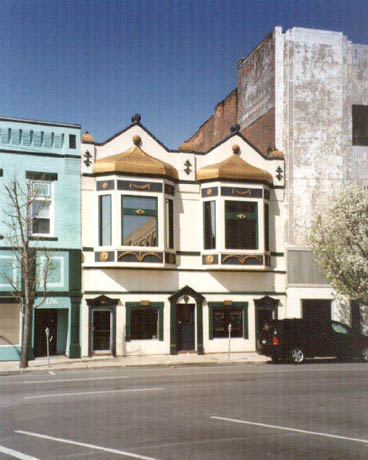 122-124 W. Walnut
Kokomo, Howard Co.
This building appears to be Arabian in
fashion; of, or being in the style of arabesque. This may put it in the
Exotic Revival style of architecture. Certainly it does not seem to
fall into any other category of architecture, except that of
combinations or exceptions. Date of this building and how much it may
have been altered is unknown.
122-124 W. Walnut
Kokomo, Howard Co.
This building appears to be Arabian in
fashion; of, or being in the style of arabesque. This may put it in the
Exotic Revival style of architecture. Certainly it does not seem to
fall into any other category of architecture, except that of
combinations or exceptions. Date of this building and how much it may
have been altered is unknown.
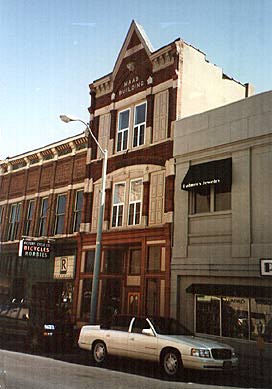 Maas Building
1888
105. W. Sycamore
This is a two-part commercial block building,
the most common form of architecture for small and moderate-sized
commercial buildings in the United States. The style is characterized
by a horizontal separation into two distinct zones that, though
separated, are nevertheless closely related visually to one another.
Maas Building
1888
105. W. Sycamore
This is a two-part commercial block building,
the most common form of architecture for small and moderate-sized
commercial buildings in the United States. The style is characterized
by a horizontal separation into two distinct zones that, though
separated, are nevertheless closely related visually to one another.
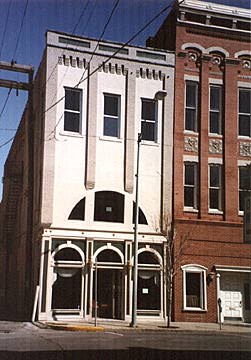 An unusual arched window marks this building,
although the original paned windows were obviously replaced with plate
glass. Two-part commercial block.
210 N. Main
An unusual arched window marks this building,
although the original paned windows were obviously replaced with plate
glass. Two-part commercial block.
210 N. Main
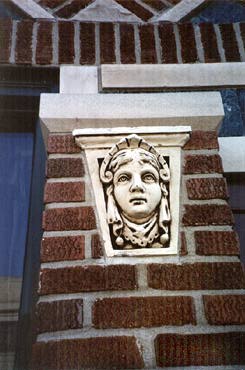 Sycamore Grill detail
West Sycamore Street
Sycamore Grill detail
West Sycamore Street
|
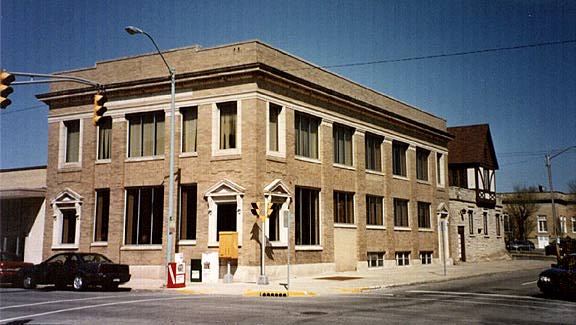
Kokomo Tribune Building
N.E. corner of Mulberry & Union
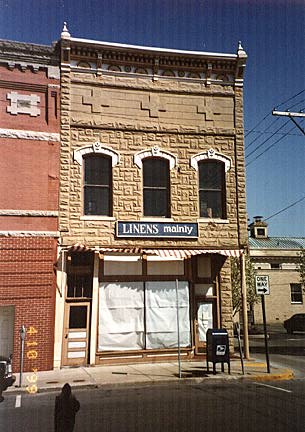
Superbly preserved shop, though apparently unoccupied as
of this picture.
Note the rusticated brick and unaltered storefront level
(unlike the building adjacent).
Two-part commercial block.
314 N. Main
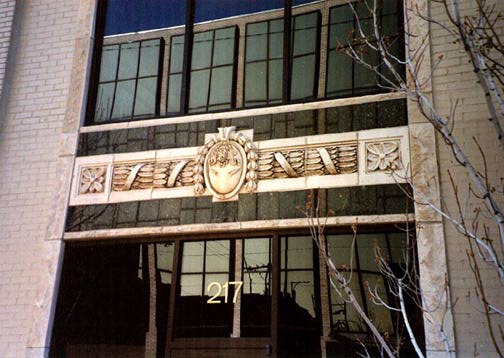
Detail, 217 N. Main
|
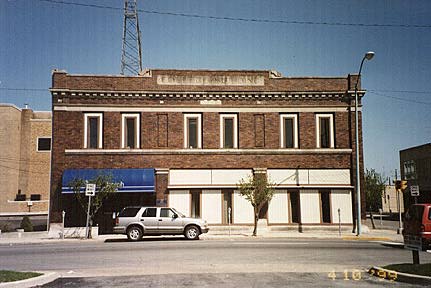
College Building
Misguided modifications over the years have
given this building an unsymetrical and boarded-up appearance.
Two-part commercial block.
1909
|
|
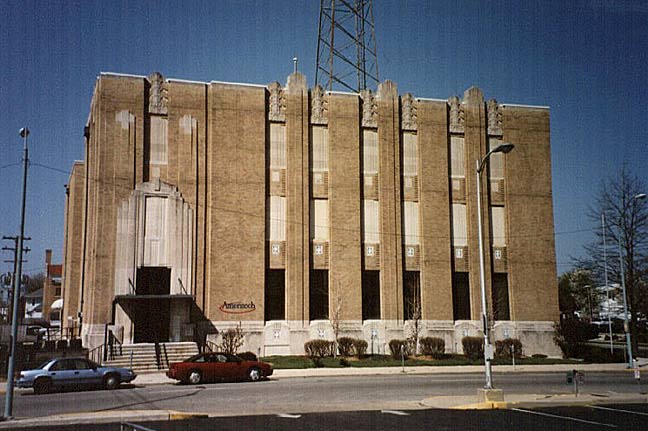
Art-Deco Ameritech Building
200 block, E. Taylor
Art Deco was a style of design popular in the
1920s and '30s, with its sleek, streamlined forms and elegant,
geometric aesthetic. Art Deco grew out of a conscious effort to
simplify the elaborate turn-of-the-century Art Nouveau style, to make
it more responsive to the new "machine-age" ideals of speed and glamour.
States Funk and Wagnall's New Encyclopedia: "It
found expression in objects as diverse as locomotives, skyscrapers,
roadside diners, radio cabinets, jukeboxes, and advertising displays.
"Primary examples of Art Deco in the U.S. are the
interior of Radio City Music Hall (1931) in New York City, designed by
Donald Deskey (1894-1989); and William van Alen's (1882-1954) Chrysler
Building (1930, New York City), with its sleek aluminum- banded facades
and arched and pointed spire."
Art Deco appears to be a popular style for
telephone and telegraph buildings, as can be seen in the Indiana
Bell Building in Evansville.
|
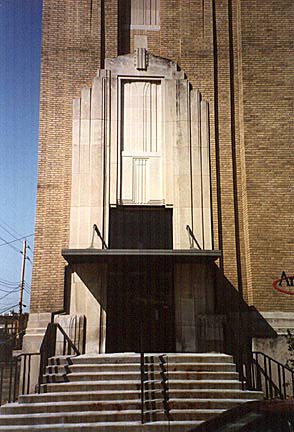
Ameritech Building
Entrance detail
200 block, E. Taylor
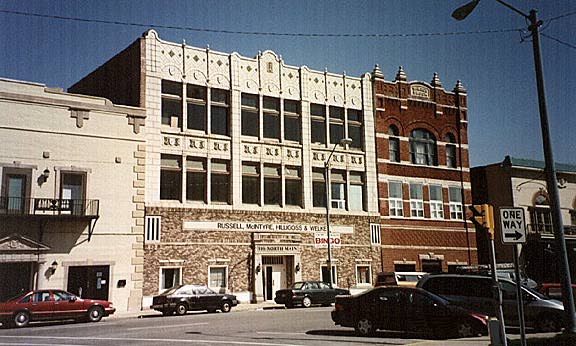
A handsome terra-cotta building, though with an
unfortunately altered storefront level. Two-part commercial block.
116 N. Main
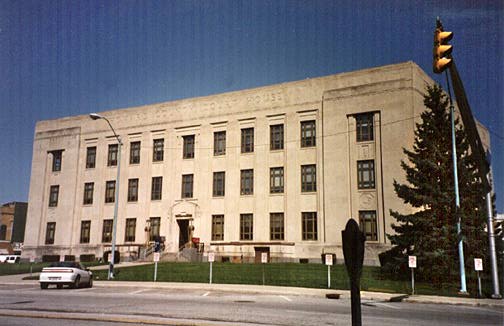
Howard Co. Courthouse
An example of Neoclassical architecture with Art Deco
elements.
|
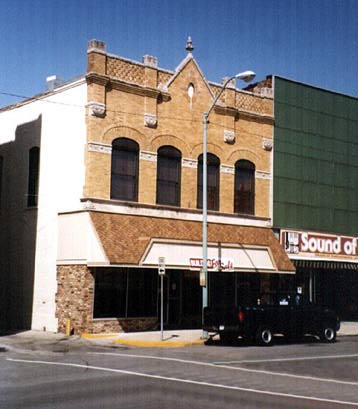
100 block W. Walnut
The bane of historic buildings: those homely
shingled awnings (and those yawn-inspiring fake facades, as seen on the
adjacent building).
|
|