|
Site Maintainer:
timarends@aol.com
Purchasing
items through this link helps pay our hosting fees
|
|
Historic Structures of
East Chicago, Indiana
Religious Structures
Despite its name, East Chicago (pop. 33,892) is not a part of
Chicago; in fact, it is not even adjacent to Chicago. It is actually in
Indiana, several miles southeast of Chicago, separated from Chicago and
the Illinois-Indiana border by the city of Hammond.
A port city on Lake
Michigan, East Chicago is the site of blast furnaces, rolling mills,
and oil refineries. The construction of the Indiana Harbor ship Canal,
as well as the steel mills, attracted dozens of industries in the early
20th century. Recently, its economy has had to diversify due to the
closing or downsizing of several industrial plants.
Many foreign-born
workers were attracted to the city during its industrial expansion,
drawn by the multitude of low-skilled industrial jobs and the
opportunity to build a better life. Workers from Western and Eastern
Europe, Ireland, Germany, Greece and other countries flocked to the
area. Later they were joined by an influx of Mexican workers.
This diversity
resulted in a marvelous collection of ethnic churches, many exhibiting
a Byzantine influence in their design. East Chicago is the home of
several important historic religious and commercial structures,
including the St. Nicholas Romanian Catholic Church (1913), one of the
city's oldest religious structures.
We apologize for not having further details on some of these
buildings. If you have more information on any of the structures on
this page, please let us know. The email link is at left.
|
|
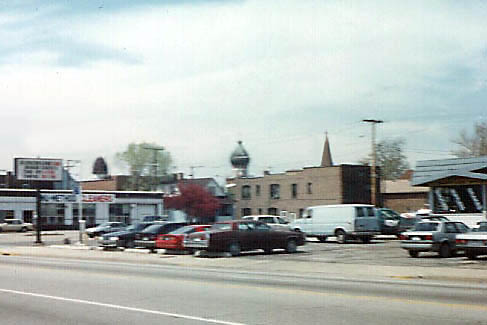
East Chicago is truly a city of churches! Numerous
steeples are visible as soon as you come into East Chicago on Columbus
Dr. from Cline Ave. This is the Indiana Harbor district of East Chicago.
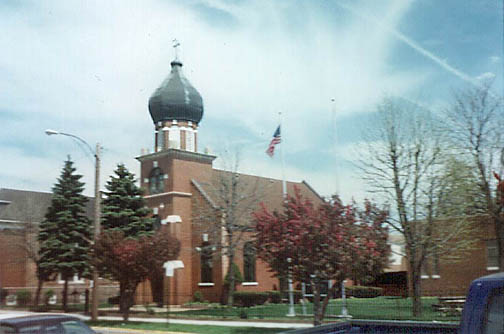
St. George Serbian Orthodox Church
(1912)
4013 Elm St.
Ethnic Revival
This building is in the Indiana Harbor
district of East Chicago.
Eastern Orthodox Churches are the major Christian
churches in Greece, Russia, eastern Europe, and western Asia. As a
federation of churches, they are united by common beliefs and
traditions. Individually, they are usually called by their national
names, such as the Greek Orthodox Church or the Russian Orthodox
Church. About 170 million people belong to the Eastern Orthodox
Churches. The canon of the Greek Orthodox Church is the same as that of
the Catholic Church, with five additional books. They are 1 and 2
Esdras, Prayer of Manasseh, Psalm 151, and 3 Maccabees.
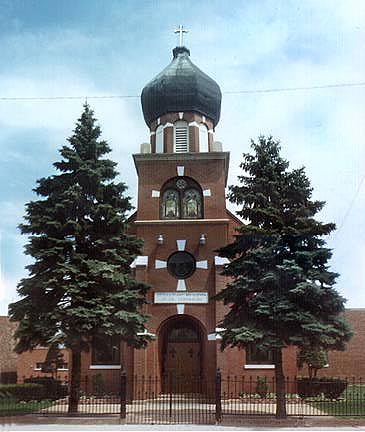 St. George Serbian Orthodox Church
(1912)
Front view
4013 Elm St.
Ethnic Revival
St. George Serbian Orthodox Church
(1912)
Front view
4013 Elm St.
Ethnic Revival
|
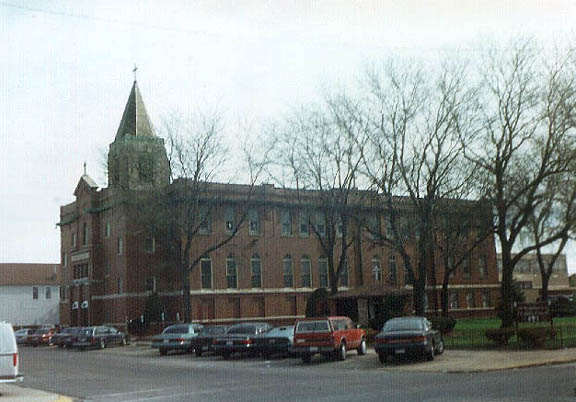
St. Stanislaus Church
Has a Polish mass every Sunday; they also run a
large Catholic School on the property.
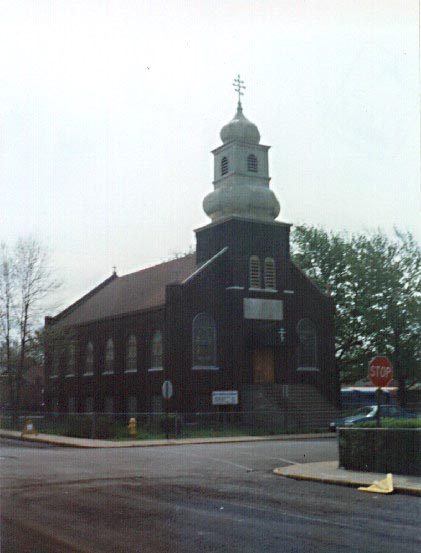 Church - Magoun St.
This quaint corner church displays a Russian
cross. This cross has two unequal horizontals set on the vertical
member above a small slanting bar. The top bar represents the
title-board, Inscribed 'INRI,' which Pilate ordered to be hung in
mockery over Christ's head on the Cross. 'INRI' in the Western
tradition are the Latin initials for "Jesus of Nazareth, King of the
Jews". The middle bar is, of course, that on which Christ's hands were
nailed, and he slanted bottom bar represents Christ's feet.
|
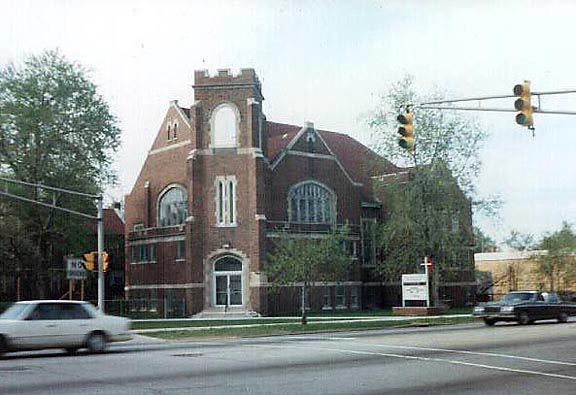
Iglesia Christiana Pentacostal
Corner of Baring and Chicago Streets
|
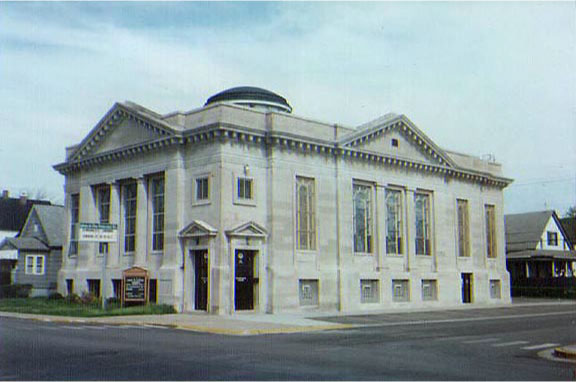
Iglesia de Dios Pentacostal M.I.,
(Formerly 1st Congregational Church of East
Chicago)
Neoclassical
145th & Magoun
1913
According to Funk & Waglalls New
Encyclopedia,
"When revolutionary movements established
republics in France and America, the new governments adopted
neoclassicism as the style for their official art, by virtue of its
association with the democracy of ancient Greece."
Neoclassical is also the style for the nation's
Capitol. Neoclassical architecture is characterized by monumentality,
strict use of the orders, or arrangement of columns, and sparing use of
ornamentation. Neoclassism was last the phase of European classicism in
the late 18th and 19th centuries.
This handsome building projects a dignified
presence.

St. Basil the Great Church
4316 Indianapolis Blvd.
Ethnic Revival
c. 1920
This building shows characteristics of the
Byzantine style of architecture. The name comes from the Byzantine
Empire, especially in the 5th and 6th centuries. This Eastern Roman
empire brought us the distinctive architectural style that features a
dome carried on pendentives over a square, incrustation with marble
veneering, and colored mosaics (note the mosiac over the doorway).
Penadenatives are the arched brick members
that support a dome over a square space, also seen above.
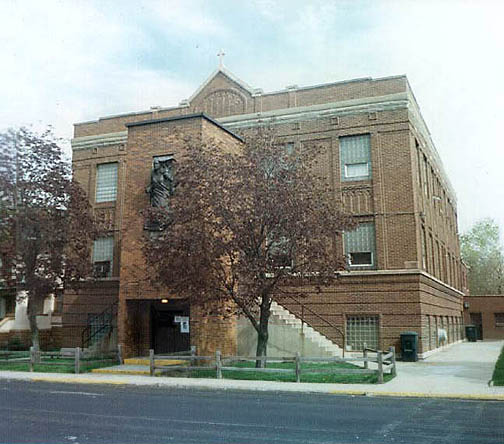
St. Mary's Parochial Elementary
School
Interesting structure includes a newer
addition, seen at the front of the building, that features a large
sculpture.
|
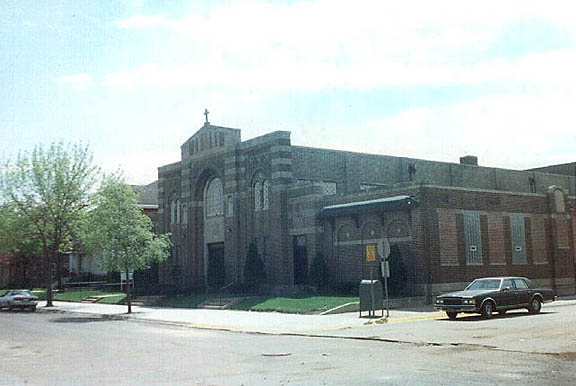
St. Patrick's Church
Harbor section of East Chicago
This building is an example of the Vault style of
architecture, which communicates massiveness, stability and enclosure
(a commonly-used architectural style for banks). The effect is somewhat
reminiscent of the fortified complexes of ancient times. In some
examples of vault architecture, the character is inspired by
Renaissance Italy or 18th-century France.
Generally two to three stories high, the vault has a
facade penetrated by a large, tall and generally narrow central
opening, and occasionally smaller ones on either side.
|
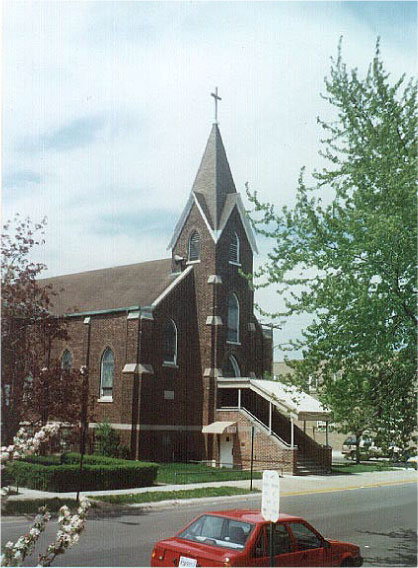
Assumption Church
Corner of 140th & Elm
Gothic Revival, 1916
Celebrating 75th Anniversary in 1997
This building is in the Indiana Harbor
district of East Chicago.
Gothic Revival was a popular 19th-century
European and American movement promoting restoration of Gothic style in
ecclesiastical and secular buildings. Notable examples are Sir Charles
Barry's Houses of Parliament (1840-60) in London and James Renwick's
Saint Patrick's Cathedral (1879) in New York City. Gothic Revival is
characterized by pointed arches and ribbed vaulting, an arched
structure of masonry forming a ceiling or roof . This broad style of
architecture stemmed from a movement of the 18th and 19th centuries
aimed at reviving the spirit and forms of Gothic architecture.
|
|
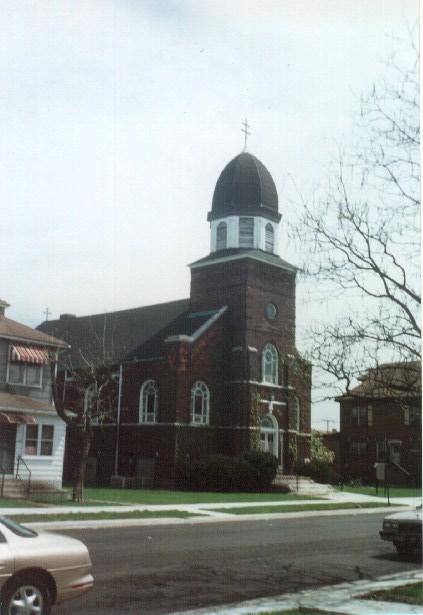
Holy Ghost Greek Church
4009 Fir St.
Renaissance Revival/Ethnic Heritage
c. 1925
Here is a quaint neighborhood church nestled
between houses on a quiet residential street. Notice how these Orthodox
churches are similar in general style to one another, but quite
different in details. Like snowflakes, no two are exactly alike.
|
|
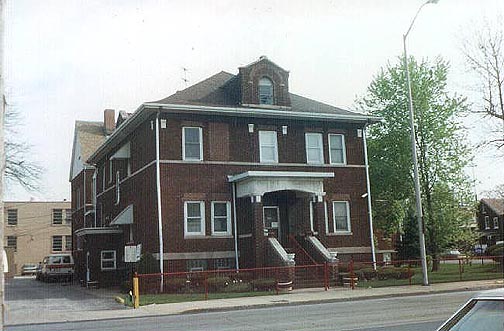
Rectory
St. Stanislaus Church
800 144th St.
This sturdy brick four-square house serves as
rectory of St. Stanislaus Church. Brick building in the Background is
St. Stanislaus School. Behind the Rectory and not visible in the
picture is the convent, where lived the many nuns who taught at the
school.
|
 St. Mary's Catholic Church (steeple)
800 144th St.
According to a site visitor (whom we thank),
a few years ago the original church caught fire but was rebuilt. This
steeple now still sits atop the newly remodeled church.
St. Mary's Catholic Church (steeple)
800 144th St.
According to a site visitor (whom we thank),
a few years ago the original church caught fire but was rebuilt. This
steeple now still sits atop the newly remodeled church.
|
The following pictures and
info were kindly provided by Connie Lamka of the
Central Baptist Church: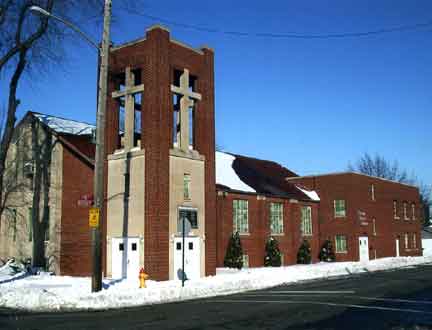 Dedication Day was November 11, 1934, and in
March of the following year, the church incorporated and reorganized
the seventy four charter members, forming the Central Baptist Church of
East Chicago, Indiana.
The church has a long, rich history of
serving its East Chicago community with children's programs,
door-to-door soulwinning, and a food pantry. Visitors are encouraged to
participate in the spirited 11:00 a.m. worship service.
Photogrph taken February 11, 2007
Click
here for a photo of the sanctuary and a full history of the church.
Dedication Day was November 11, 1934, and in
March of the following year, the church incorporated and reorganized
the seventy four charter members, forming the Central Baptist Church of
East Chicago, Indiana.
The church has a long, rich history of
serving its East Chicago community with children's programs,
door-to-door soulwinning, and a food pantry. Visitors are encouraged to
participate in the spirited 11:00 a.m. worship service.
Photogrph taken February 11, 2007
Click
here for a photo of the sanctuary and a full history of the church.
|
[ Home | Images of Indiana
Architecture | Endangered
| Editorials
| Site Store
]
[10 Simple ways you
can help promote Historic Preservation! ]
|