|
Site Maintainer:
timarends@aol.com
|
|
Historic Buildings of
New Albany, Indiana
Commercial Structures
New
Albany was founded in 1813 by Joel, Nathaniel, and Abner
Scribner of New York. They laid out the town and sold lots for
commercial and residential areas, reserving areas for school, church,
and government purposes. The town prospered at the falls of the Ohio
River and was the largest city in Indiana in the 1850s. Leading
industries in the 1800s were shipbuilding, furniture and woodworking,
glass works, woolen and cotton mills, and leather manufacturing.
Churches and schools were numerous and the arts flourished. New Albany
was a southern Indiana center for banking and goods. Leading citizens
of the 1800s built their homes on Upper High Street, later renamed Main
Street.
(Information from Walking Tour Map of Mansion Row
- Susan Adams, David Barksdale)
All pictures contributed by David Barksdale
|
 Indiana State Bank
, 203 E. Main. One of ten
original branches of the Indiana State Bank, this building was designed
by Edwin Peck and built in 1837 by Hugh Pugh in the Greek Revival
architectural style.
Indiana State Bank
Indiana State Bank, 203 E. Main. One of ten
original branches of the Indiana State Bank, this building was designed
by Edwin Peck and built in 1837 by Hugh Pugh in the Greek Revival
architectural style.
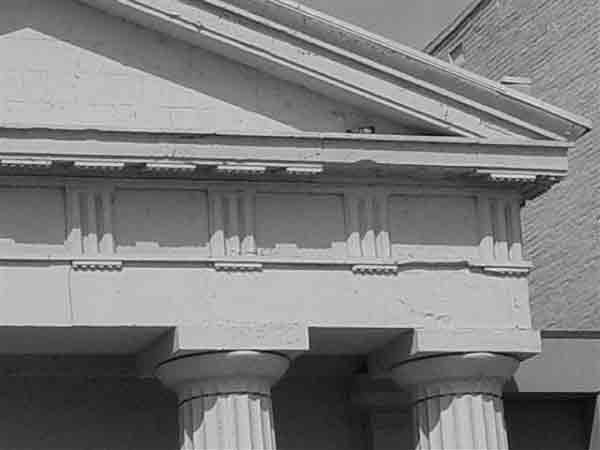 Indiana State Bank
(Detail)
An interior design studio and banquet facility are
housed in this fine building.
Indiana State Bank
(Detail)
An interior design studio and banquet facility are
housed in this fine building.
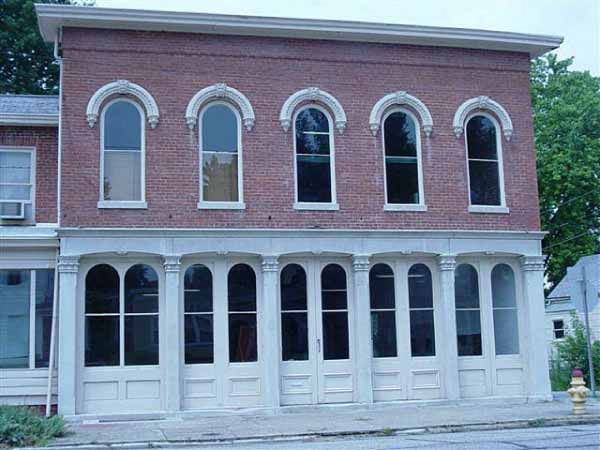 F. L. Sieveking Grocery Building
Now The Seed Workshop & Art Gallery.
1515 East Market Street
Italianate, c.1875
F. L. Sieveking Grocery Building
Now The Seed Workshop & Art Gallery.
1515 East Market Street
Italianate, c.1875
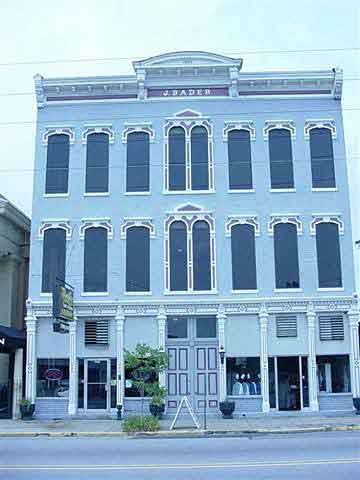 J. Bader Building
207 and 209 East Main Street
Italianate
1885
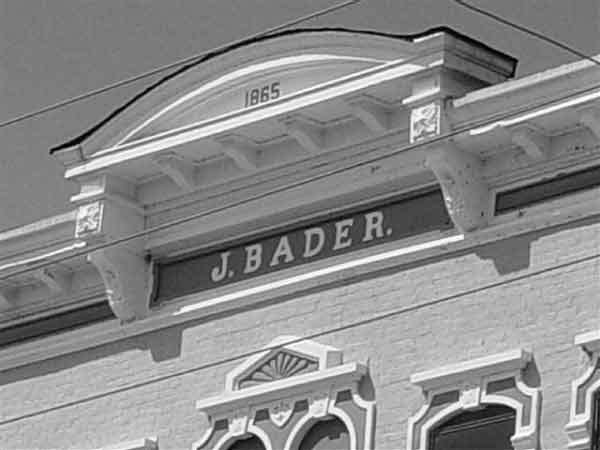 J. Bader Building
207 and 209 East Main Street
Italianate
Built 1885 (Painter goofed)
|
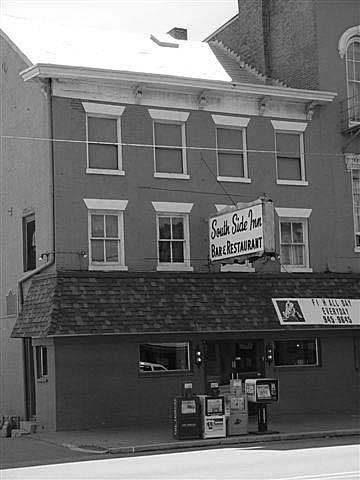
Dr. Asahel Clapp House,
114 E. Main.
The oldest brick house, which was built in 1822,
was the home and office of New Albany's first doctor. The building was
originally only a two-story structure; the third story was added in the
1860s. A historical plaque is located on the east side.
|
|
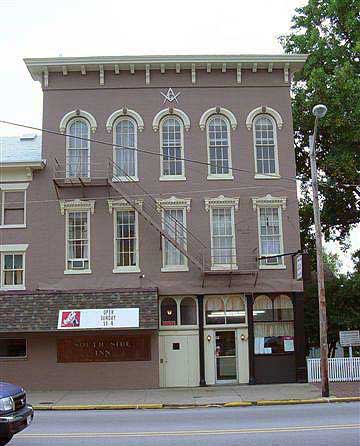
Masonic Hall, 110 E. Main
1868
Was the Masonic Hall for the Dudley Temple of
Honor.
Built in 1855 in the Italianate style. Note the
Masonic emblem at the top of the building.
These two buildings house a popular restaurant.
(If only we could get rid of that awning!)
|
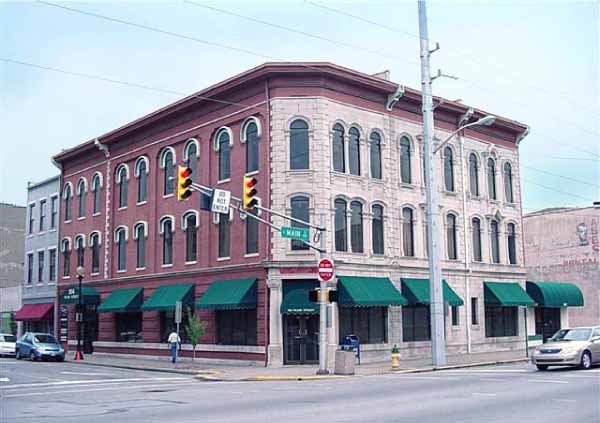 Merchant's National Bank, 1869
Corner of Pearl and Main streets
Merchant's National Bank, 1869
Corner of Pearl and Main streets
Founded by Jacob Hangary and Robert McCord, this
structure of Italianate architectural style was built on an 1830 bank
site. Even as early as 1905 it went through an extensive remodeling. It
now houses several offices.
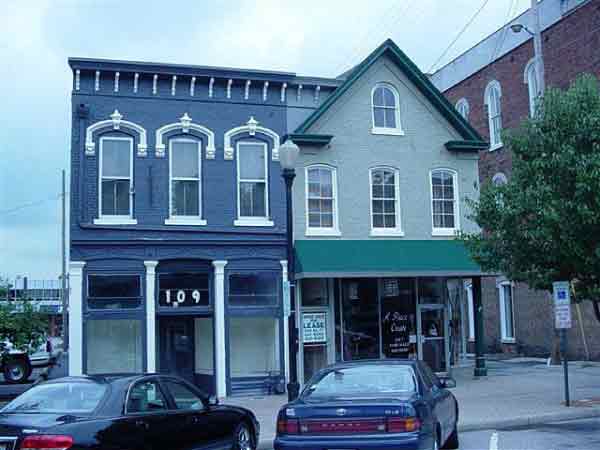 109 and 113 East Market Street:
109, The Globe Store; Italianate, c.1870.
113, McDonald Drug Co.
Gabled-front
Says contributor David Barksdale, "I see some
Greek, Gothic and Italianate influences
c.1870? (my guess 1850s)"
109 and 113 East Market Street:
109, The Globe Store; Italianate, c.1870.
113, McDonald Drug Co.
Gabled-front
Says contributor David Barksdale, "I see some
Greek, Gothic and Italianate influences
c.1870? (my guess 1850s)"
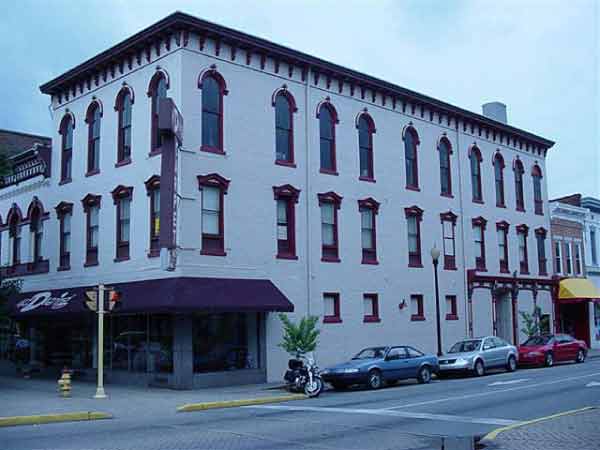 The Briggs Block
Northwest corner of Pearl and East Market streets
Italianate, 1872.
The Briggs Block
Northwest corner of Pearl and East Market streets
Italianate, 1872.
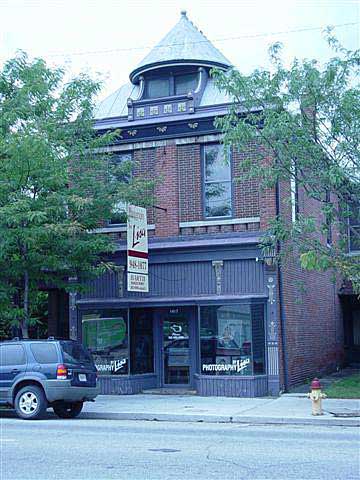 1417 East Spring Street
Queen Anne, 1892.
1417 East Spring Street
Queen Anne, 1892.
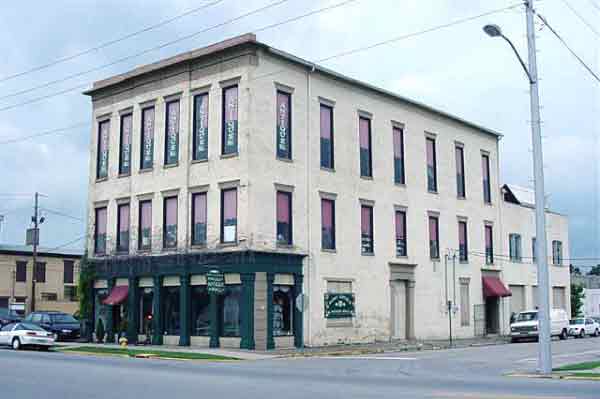 Woodward Hall
128 West Main Street
1852
Says contributor David Barksdale, "Several people
feel this building has strong Egyptian Revival features, such as the
concave cornice and storefront and the bundle-shaped columns.
"The first Indiana performance of Uncle Tom's Cabin
was given here. During the Civil War the third floor Hall and 2nd floor
was used as a hospital. Today it is a popular antique mall."
Woodward Hall
128 West Main Street
1852
Says contributor David Barksdale, "Several people
feel this building has strong Egyptian Revival features, such as the
concave cornice and storefront and the bundle-shaped columns.
"The first Indiana performance of Uncle Tom's Cabin
was given here. During the Civil War the third floor Hall and 2nd floor
was used as a hospital. Today it is a popular antique mall."
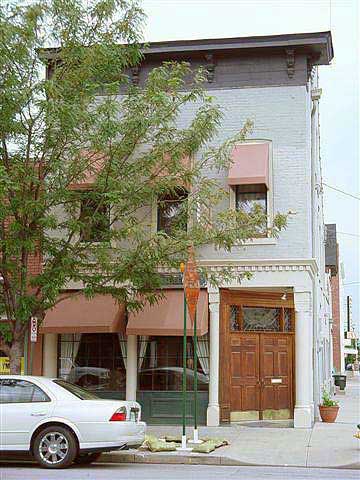 John E. Noyes Building
I157 East Main Street
Italianate, 1868.
John E. Noyes Building
I157 East Main Street
Italianate, 1868.
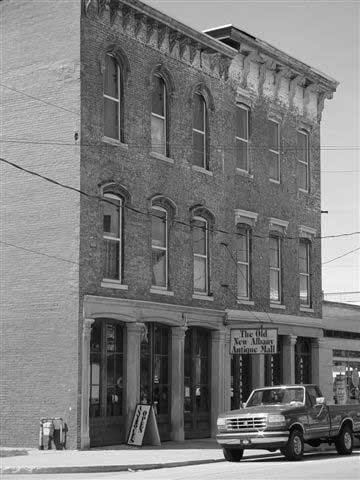 New Albany Antique Mall
223 & 225 State Street
Italianate
c. 1870
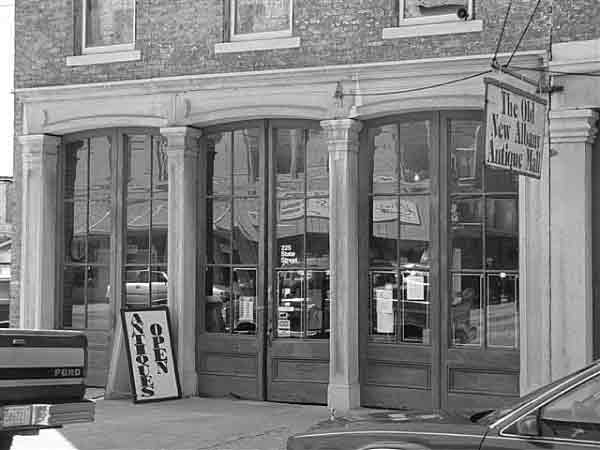 New Albany Antique Mall
223 & 225 State Street
Italianate
c. 1870
Detail of storefront level
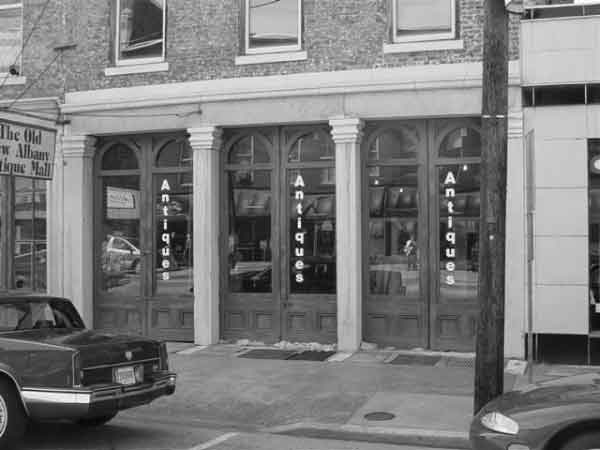 New Albany Antique Mall
223 & 225 State Street
Italianate
c. 1870
Detail of storefront level
[ Home
| Images of Indiana
Architecture | Endangered
| Editorials
| Site Store
]
[10 Simple ways you
can help promote Historic Preservation! ]
|